
"Ain’t in LA" by Adéla: A Bitter-Sweet Tale About Immigrating to Chase Your Dreams

Updated: Aug 24
From her roots in Eastern Europe to the Billboard charts: how the Slovak singer-songwriter has turned the struggle of ambition and migration into a potential generational anthem.

Since bursting onto the music scene with her debut EP, The Provocateur, Slovak singer-songwriter Adéla has given people plenty to talk about. Her hot pink hair, dark hyperpop sound, defiant lyrics, and the incorporation of ballet into a seemingly raw universe have given her an unmistakable brand image.
However, the push she needed to achieve global acclaim has come from what is likely her least experimental, yet most personal, song to date.
Ain’t in LA, a track inspired by Miley Cyrus’s We Can’t Stop, released over a decade ago, uses Adéla's own musical influences to tell the story of how she immigrated from Slovakia to the United States to fulfill her dreams. Yet, this song is not just about her.
It is a story about immigration, the need for representation, and the power of dreams.
"Their dreams don’t live at home"
The idea for Ain’t in LA was born when Adéla found old photos of her mother, who, back in communist Bratislava, created her own Western-inspired style by wearing hand-me-down clothes. Her story represents a pre-globalization generation for whom moving abroad, whether to thrive or pursue a calling, was practically unthinkable.
However, in the pre-chorus, Adéla sings that "she is taught that her dreams don't live at home." That is where she begins speaking not just for herself, but for the generations born from the nineties onward: millions of adults and teenagers raised in front of screens that taught them to dream, specifically, to dream the American Dream. They are young people with ambitions their parents and grandparents could never have imagined, but fully aware that to achieve them, they will almost certainly have to leave home; otherwise, they might never make it.
It is this message directed at "all of the girls in them unknown cities" that has allowed the song to travel around the world. Ain’t in LA is not a track for passive listeners; it is an echo for all those people who, like Adéla herself, dream and have accepted that they must migrate, whether to another city or abroad, to build their future. And these dreams are not limited to grand feats like succeeding in the music industry. They can be everyday aspirations, such as becoming a doctor, a teacher, or an engineer, or even something as fundamental as simply having a roof over their head and living in peace.
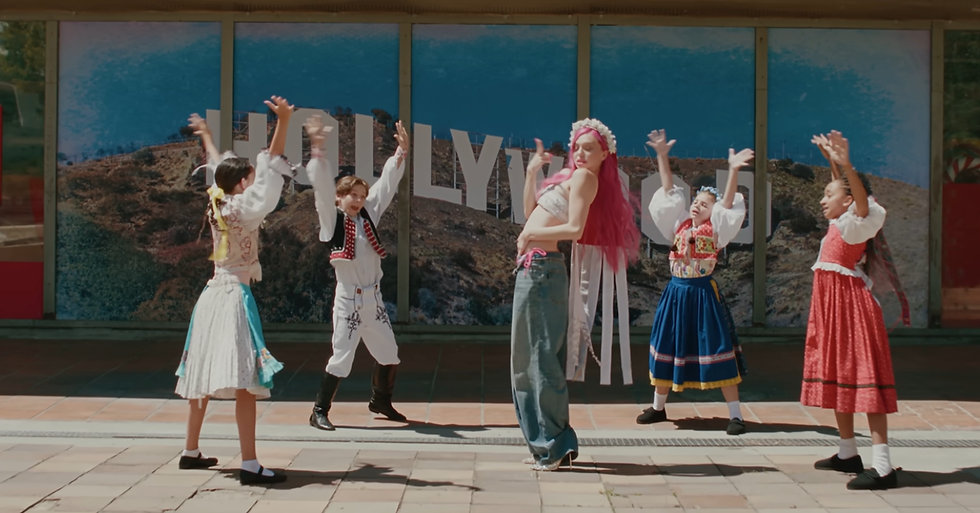
Perhaps the most moving scene in the music video, as well as the one that best captures the song's message, is the moment when the singer dances surrounded by a group of children dressed in traditional Slovak attire. A perfect juxtaposition is created here: the children perform hip-hop steps, a genre created by African Americans in working-class neighborhoods, wearing their country's folk clothing in front of a Hollywood sign set up in a working-class district of Bratislava.
Among the dancers is a Black Slovak girl, and her presence adds a crucial layer to the message: the very country Adéla had to leave in search of better opportunities is, in turn, home to a new generation whose parents also sought a better life. It is proof that identities and maps are changing everywhere, driven ultimately by the simple act of dreaming.
A milestone for Adéla and Slovakia
The imagery is striking not only in relation to the song itself. For those who have followed Adéla's career since Dream Academy, the reality show produced by the Korean entertainment company Hybe to form the group now known as Katseye, this scene recalls a rather controversial moment from her brief time on the show.
Shortly after Katseye's debut, the production company released a documentary featuring unseen footage from Dream Academy. One segment showed a group therapy session with a psychologist aimed at easing tensions the contestants felt with themselves and their peers due to the pressure of the show. The American trainees expressed feeling that they were not receiving as much attention as the foreign candidates, who received supportive messages from both their compatriots and people from neighboring countries simply because of their nationality. To this, Adéla responded that "Americans are finally experiencing what Slovaks always feel, since they never have representation."
It was precisely the use of that word, "representation," that sparked a wave of debate on social media, leading to personal attacks and insults against the singer.
Today, there is a broad consensus on the importance of media representation; as journalist Gloria Steinem famously noted, "if you can't see it, you can't be it." Case in point: following Spain's victory in the Women's World Cup, the number of registered female soccer players rose by 15.8% compared to the previous year. How many of them would have even considered touching a ball without the triumphs of Alexia Putellas, Salma Paralluelo, or Aitana Bonmatí?
We owe thanks to the American sociologists, journalists, and thinkers of the late 20th century who brought attention to the need to see oneself reflected on screen. However, this theoretical framework carries a double-edged sword: by monopolizing the conversation around representation, American culture also claims the authority to decide what is valid and what is not, who needs it, and who lacks it. In Adéla's case, the dominant narrative on social media dictated that, because she is white, she could never suffer from a lack of representation.
Through the American lens, Adéla falls under "whiteness", a catch-all category that reduces all Europeans, excluding, initially, though not currently, Southern Europeans, to a homogeneous mass whose ultimate fate is assimilation into WASP (White Anglo-Saxon Protestant) hegemony, the cultural legacy of Anglo-Saxon settlers.
The artist herself has admitted that, as a white European immigrant, she is less likely to experience discrimination in the United States than her counterparts from Global South countries. However, this does not invalidate her point during Dream Academy. Yes, white people receive overwhelmingly positive representation in American culture and, consequently, global culture; but those white figures are the Smiths, the Johnsons, and the Williamses. The Jergovás like Adéla, the Shevchenkos and the Kowalskis are relegated to roles where, regardless of their actual country of origin, they must exaggerate a Russian accent to portray villains, criminals and prostitutes.
Ain’t in LA has therefore served as a breath of fresh air, not only for dreamers across Eastern Europe, but for anyone from countries stereotyped by the very Hollywood they dream of joining.
Three years ago, Adéla was the first contestant eliminated from Dream Academy. Today, she is the first Slovak in history to enter the Billboard charts. Hopefully, her milestone paves the way for Eastern European artists, and artists worldwide, who will follow, and above all, hopefully, local talent will no longer need the validation of the American industry to achieve global success.
Ain't in LA is the third single from her debut album, Prima, which will be released on September 4th along with other tracks such as KGB or Red Bottoms.


